Free shipping with purchases of €20

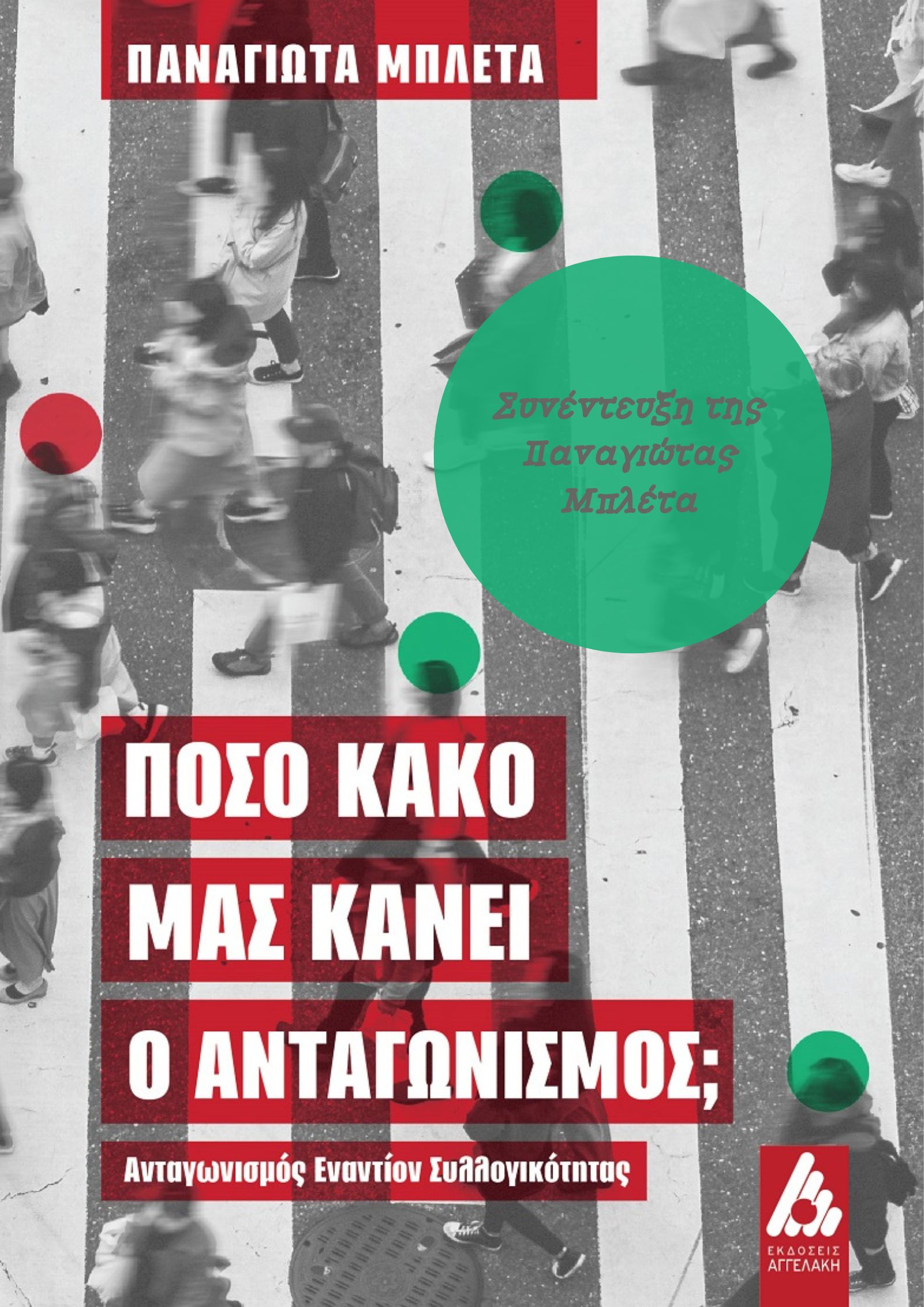
Panagiota Bleta’s interview with Marika Arvanitopoulou

How are the apparent “positives” of competition interpreted within the context of the book and in which areas do they appear as dominant perceptions?
In the public consciousness, but also in the rhetoric of the market and technological progress, competition is often presented as something positive. It is considered to mobilise productivity, encourage innovation, promote individual progress and set the bar high in everything we do. This perception is pervasive: we see it in the economy, in education, in sports, in politics, in our social and personal lives – everywhere, where surpassing the other or others is taken for granted.
But in my book I argue that all these are nothing but illusions. They are fabricated arguments of a system based on pressure, exclusion and burnout. The so-called progress brought about by competition is not based on collective benefit, nor on the inner flourishing of man, but on the imposition of the most privileged and the rejection of the most vulnerable.
That is why I ask a very simple but essential question: Progress on what? And for whom? If the price of progress is stress, mental deterioration, social inequalities and environmental destruction, then we are not talking about progress – but about carefully decorated decline.
Therefore, those “positives” attributed to competition are not innocent. They are social fantasies that legitimize the injustice and violence of a system that has ceased to see man as an end and now treats him simply as a tool.
Therefore, for me there are no real “positives” in competition. There are only narratives that have been imposed on us, in order to convince us that the world cannot function otherwise. And this faith, as long as it is preserved, prevents us from imagining something deeper, more just and more human.
What are the objections or reservations expressed in the book about the human and environmental costs of competition?
My book focuses on showing that competition – however “natural” or “necessary” it may be presented – is in fact a cultural construct that has profoundly undermined both humanity and the balance of the planet.
From the human point of view, the consequences are first and foremost mental and existential. Competition produces people who live under constant pressure to prove their worth through comparison with others. This generates anxiety, inner emptiness, loneliness, but also a loss of meaning in life – because when you live to surpass someone, you stop living for yourself. Man is transformed into an accessory of a measuring machine, and not into a carrier of inner truth, creativity and mental freedom.
At the social level, competition erodes solidarity. It trains us to see the other not as a companion or partner in life, but as an opponent, an obstacle, a threat. And this inevitably leads to social inequality, moral withering and a society that ceases to have a face – it has only numbers and performance.
And of course, the environment pays the price. Competition in the economy leads to insatiable consumption, to the depletion of natural resources, to systematic violence against nature. The Earth is treated as an object of exploitation, not as a living Mother. The ecological crisis is not a random phenomenon; It is a systemic symptom of a culture that seeks to prevail, not to coexist.
I’ll say it clearly: competition kills. It kills trust, empathy, peace of mind, the sustainability of the world. It is a cultural virus that has taught us to live in constant war, instead of harmonious coexistence.
My book is not a theoretical rejection of competition, it is a proposal to re-establish human society on the basis of other values: cooperation, care, mutual respect and a shared vision of a world worth living in.
Is there an alternative development model?
Yes, there is an alternative model of development – and we must now design it with awareness, responsibility and collectivity.
This model is not based on competition but:
In cooperation, where the progress of one feeds the progress of all.
· In social and ecological responsibility, which puts barriers to greedy development.
· In emulation, not as a battle, but as inspiration and mutual elevation.
· In self-sufficiency and sustainability, not in over-consumerism and exhaustion.
· In the education of relationship and not of dominance, where children learn to co-create and not to compete.
I believe that this alternative model is not a utopia – it is a moral necessity and a cultural challenge that we can no longer ignore. It is not a distant affair, but something that can start now, from the way we live, how we think, where we teach, where we operate.
My book is a call in this direction. Not just to say “no” to competition, but to dream and build a world where progress has no victims.