Free shipping with purchases of €20

Interview of Paraskevi Togialos with Marika Arvanitopoulou

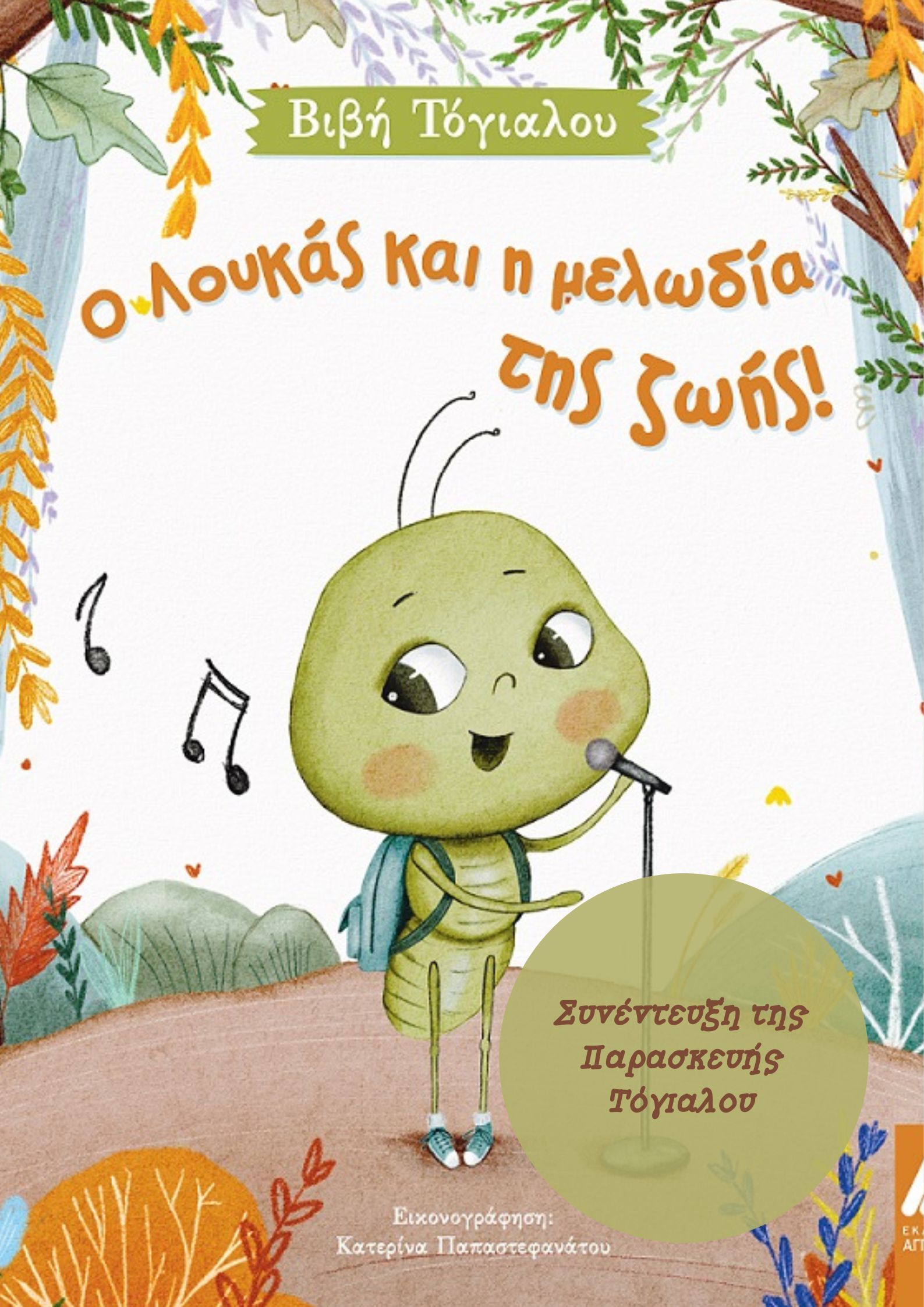
1. Will you introduce Loukas to us? Does the cicada Loukas learn to love his diversity through his song?
Loukas is a small cicada who carries his own “secret”: one of his feathers is smaller than the other. This means that it cannot fly like the rest. And yet, through this difficulty, he discovers his true treasure, the melody he hides in his heart. Luke teaches us that diversity and any difficulty we may have does not define us negatively, on the contrary, it can become our strongest “song.”
2. The main themes of the book are friendship and acceptance, what other themes did you want to go through with the use of allegory?
Through Luke I wanted to talk about perseverance, about the courage to keep moving forward even when the path seems difficult. Also, about the value of self-awareness and the inner voice, because sometimes what we cannot do with our “wings” we can do with our soul. The allegory works like a mirror: it shows children that weakness is not an obstacle, but another path that can lead to something great.
3. To which ages is it addressed?
The book is mainly aimed at children 3-6 years old, in preschool and first school age. However, the messages are timeless and can also touch older children and even adults! As I always say, we don’t just read children’s books as a narrative to children but we also read about the “child” inside us!
4. Do you think that fairy tales shape a personality from soft nails?
Absolutely. Fairy tales are the first way in which children come into contact with the world of values, feelings and relationships. Through stories that “speak” to their imagination, children learn how to see themselves and the world around them! Concepts and situations that we sometimes find difficult to explain to children pass indirectly through the stories of the fairy tales themselves!
5. What was your inspiration for talking to children in such a simple but profound way about acceptance?
The inspiration came from the small moments I have seen in the children’s daily lives, either in the classroom or outside of it. Those moments when a child hesitates, when he feels that he “can’t” or that he is “different”. For the moments when we happened to feel “Loukas” ourselves or when we met a “Luke”. I want children after reading the book to learn how to help, support, believe in themselves and their potential! The simplicity of the text is hidden in the choice of understandable meanings, without hiding the peculiarity of the hero.
As a society, we tend to either “hide” diversity or overemphasize it in order to raise awareness. But what is really needed is to see it not as “something special”, but as part of life, something that exists and accompanies us. This is what Luke comes to highlight. Not so much its diversity but the value of being yourself!