Free shipping with purchases of €20


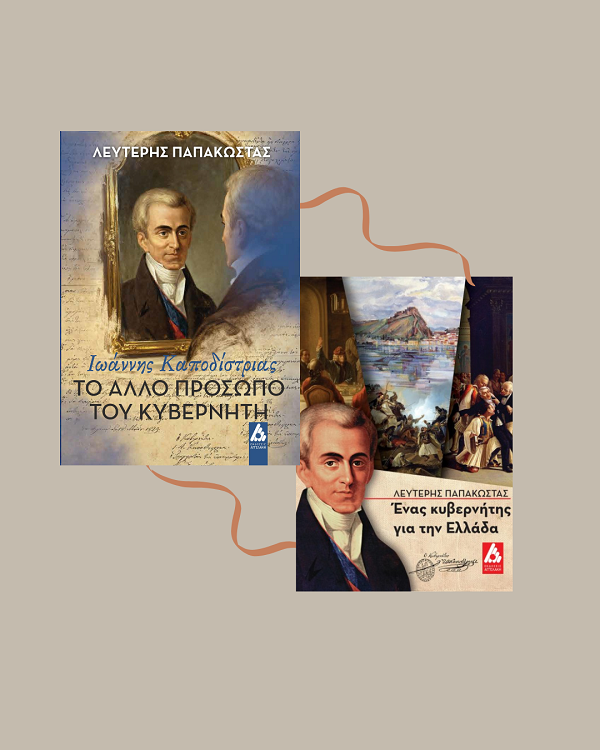
About: “The other face of the governor”
The sketch of the personality of Ioannis Kapodistrias is the subject of my second book, “The Other Face of the Governor”, which is dedicated to the first Governor of Greece.
Much of the research is based on rare archival material or personal letters sent by Ioannis Kapodistrias to various personalities with whom he was associated from the first moment of his appearance on the political scene of his homeland Corfu until the dawn of the day he was assassinated, on 27 September 1831, in Nafplio.
Through this material a completely different person is presented than the one that official historiography has portrayed for Kapodistrias. The noble and sensitive Corfiot aristocrat is transformed, when necessity dictates, into a tough and resilient warrior who crosses, in unbearably cold conditions, the whole of Europe following the Tsar’s troops in the fight against Napoleon, who represents for Europe a new kind of tyranny.
Through personal confidences, his anguish is revealed, but also his faith that despite the difficulties he will manage to uplift his tortured people, to eliminate injustices and to create a favoured society with European characteristics.
Unfortunately, for him and the country, his passion and effort were not enough to overcome the perfidy, bigotry and vindictiveness of his political opponents. His assassination, however, which moved the entire nation, was the beginning of the acquaintance with a personality who, though ruthlessly eroded, even today, 194 years later, is the model of a statesman whose unjust death saddened even those who sought his demise.
About: “A Governor for Greece”
The book “A Governor for Greece” is a book dedicated to the first Governor Ioannis Kapodistrias. A personality whose policies and choices provoked both rave reviews and severe criticism, both from the opposition of the time and from much of modern historiography.
The aim of this book is to present to the general public, with the greatest possible objectivity, the work, politics and choices of Ioannis Kapodistrias, whom Dimitrios Vernardakis describes as “a person unknown to us” and who, one hundred and eighty-six years after his assassination, has the potential to evoke a variety of emotions, to problematize and to fascinate at the same time.
Was Kapodistrias the great politician who was honoured and hated by European diplomacy for his excellent abilities or the person whom Apollon by Anastasios Polyzoidis disparagingly calls a “tyrant and oppressor” and who incited against him the political and military leadership of revolutionary Greece?
To all these questions the book attempts to give convincing answers which may provoke the reactions of both those who want Kapodistrias to be a martyr and those who condemn him as an authoritarian and undemocratic tyrant. But it is a long, conscious effort not to “canonize” him, but to introduce the great politician in depth to the reading public and to help them evaluate his contribution, if any, to Greece in the early stages of its free life.





Reviews
There are no reviews yet.