Free shipping with purchases of €20

Interview of Antonis Konstantinou with Marika Arvanitopoulou

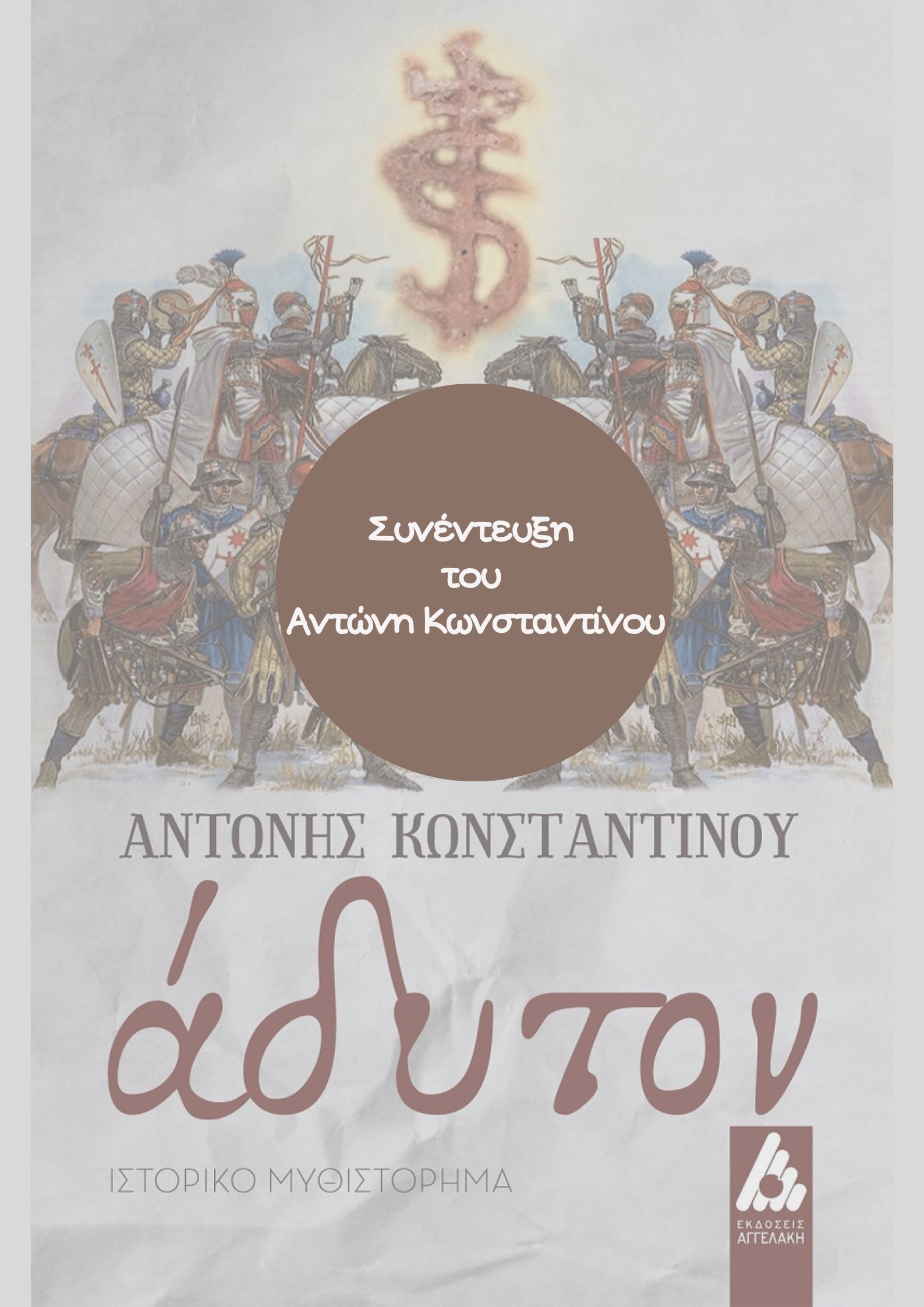
1. The Sanctuary is a historical novel that draws its elements from which period?
The Sanctuary is a fictional rendition of a historical research that draws elements from the period of the Middle Ages to the present day. At the same time, however, it aspires to penetrate issues related to universal human concerns and truths of a philosophical, religious and historical nature and, directly or indirectly, draws elements from the entire range of human history and the human spirit.
2. Is there a detective plot in your story?
Yes, although this was not an end in itself. The evolution of the play from a purely historical to a detective novel occurs in a way inevitably, as if imposed by the very course of events. This symbolically conveys the deeper message that the search for truth is not without danger. At the same time, however, the detective plot serves the literary presentation of the results of historical research and aims to keep the reader’s interest unchanged until the last page.
3. What was the reason for writing The Dyton?
The historical research described in the book is real. Its results were published in the Yearbook of the Cyprus Society for Historical Studies, issues 14 and 15. This was preceded by many years of study of the bibliography and search for information in medieval and other archives as well as an exchange of views with scientists-researchers in Cyprus and elsewhere. At some stage I decided to share this fascinating journey through the sources of knowledge and history with my readers, interspersed of course with fictional elements for the purposes of literary presentation.
There was one more reason. In discussions with the researchers, I found that, on a purely personal and private level, we had no difficulty in agreeing that an objective and unbiased examination of historical events would overturn many of the established interpretations given in retrospect to serve specific historical narratives. I inadvertently remembered an old saying that since ancient times the truth had to be dressed in the mantle of myth and allegory in order to protect itself from the prevailing beliefs.
Pulled a little by the hair, but that’s how the idea of writing a novel as a vehicle for the free reading of history came about.
4. Why do you characterize it as a peculiar historical novel?
Because the Sanctuary does not obey the established rules of similar historical works. It is historical and at the same time detective. His case is progressively folded through the findings of a hypothetical investigation that is being conducted in Cyprus, Brussels and London and lasts very little time. The research includes many authentic elements and in places acquires an almost academic character with multiple references to historical sources and photographic material. The work thus acquires greater convincing and allows the reader to travel to the past, to penetrate into unseen and occult aspects of historical events and to experience the grandeur and destructive fury of many of their protagonists.
A second peculiarity of Adyton is that it covers about a thousand years of Cypriot and European history. This is achieved through extensive flashbacks to the past that focus on the life and action of important historical figures and at the same time broaden and enrich the results of the hypothetical research carried out in the present time. Historical events are thus elaborately integrated into the fiction of the work, creating a complex historical narrative that highlights known and unknown aspects of Cypriot and European history and reveals a different side of things.
5. How much time did you spend gathering information about your story?
A total of about five years.
6. We read in your CV that since 2012 you have been writing all the time? Specifically after your retirement. So as if you have been ready for many narratives for a long time?
Yes, exactly. Previously, there was no time for such activities. My professional and family obligations absorbed the last ounce of my strength. Circumstances changed dramatically after my retirement. So far, four of my books have been published, two of which will soon be released in an online edition in English and later in German. But the supreme judge of every writer is the reader and I hope he will vindicate me.
7. Are we living in an era when people both write and read? But why doesn’t spirituality characterize our time?
I have the impression that in Greece people read a lot, possibly above the European average. There are also many writers and people who at some point feel the need to pick up the pen and record their thoughts and experiences. As for quality, opinions differ. But at a time when man is bombarded daily with countless ‘stories’ and all kinds of artificial ‘spectacles’, having at the same time to take care of his daily living and the needs of his family, he has become accustomed to acting as a superficial consumer. He does not feel that he has much room for complex spiritual pursuits. The conditions favor the return to some stable values, but behind this trend lurks the danger of fatalism and fundamentalism that must be fought in every way.
8. What will be the story of your next book?
My next book has already been published by ANGELAKIS. It bears the title LOUIZA TZANOU and the subtitle “The diary of a guerrilla soul”. It is the true story of a heroic and risky Greek woman from the period of the Occupation and the guerrilla who, due to her daring character and rebellious mentality, is involved in numerous adventures in order to survive herself and her loved ones. Her younger brother was slaughtered by the security battalions of Athens and turned into an idol of the Greek youth. A second brother of hers is in the hands of Mussolini’s blackshirts.
In the midst of the consequences of the inhumane plague of the Occupation, only weeks before the Holocaust of her place of origin and the entire area of Kalavryta, Louisa does not hesitate to take daring initiatives to save her brother and ends up being accused of non-‘Greek’ behavior. The Partisan Court condemns and vindicates her successively, asking her to take over the leadership of the women and to transmit to them her unenslaved and unsubmissive spirit.
Will he manage to become a new Tsavelena or will he prefer to flee to the anonymity of occupied Athens?