Free shipping with purchases of €20

Interview of Katerina Makantani with Marika Arvanitopoulou

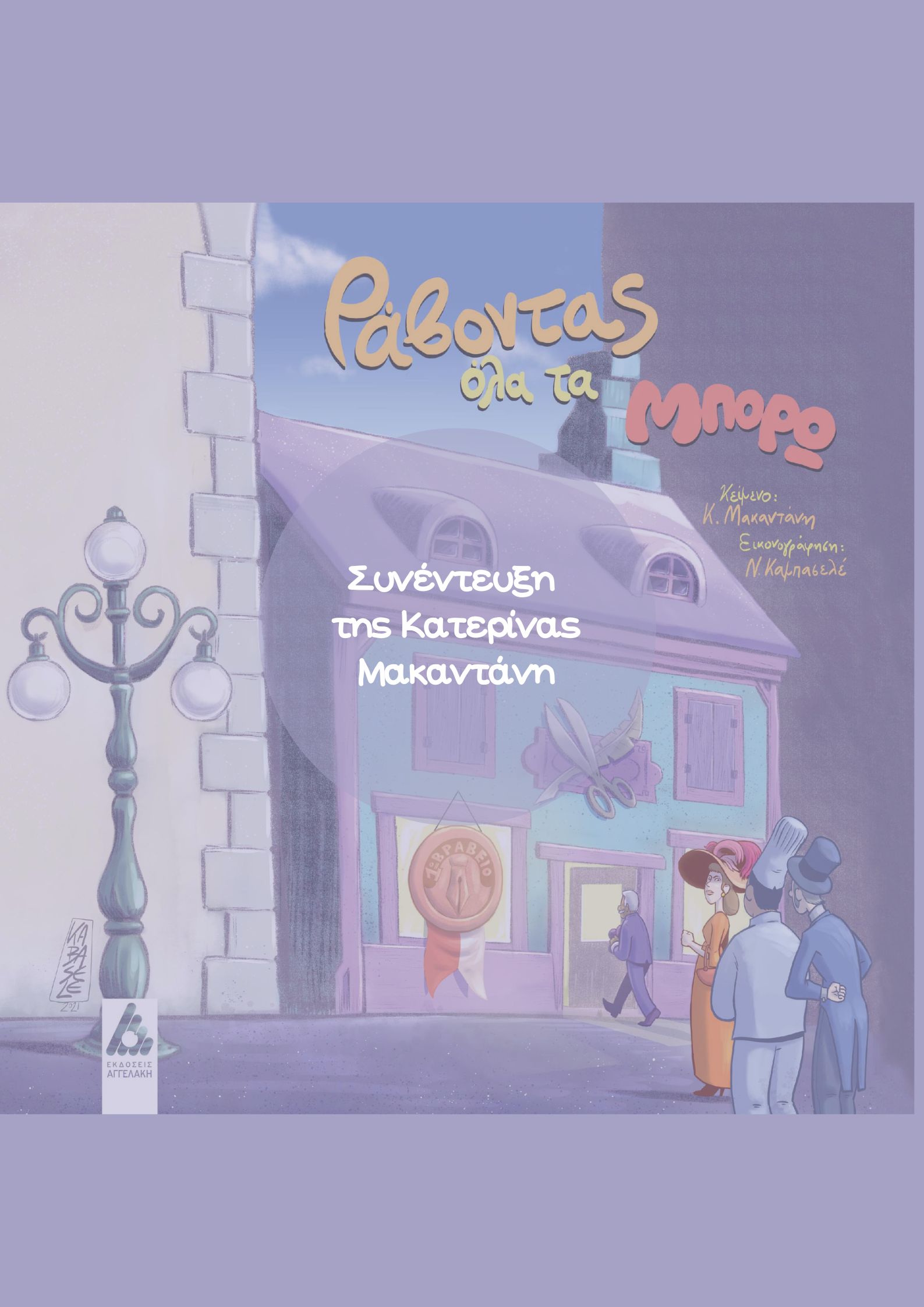
1. At what age is your book Sewing All I Can?
My book is aimed at kindergarten children up to the last grades of elementary school.
The role I have as an educator is a positive element that contributed to the writing of my first children’s book and motivated me. But I will tell you with confidence that this is not enough to be able to address and approach children. I think that what played a more important role is that I feel and am a child myself. I speak their language and feel them.
3. In your opinion, what is today’s childhood? Do we raise children with fears, guilt, free, free from propriety and strictness?
Very important question! Today’s childhood is going through a crisis; and in fact, childhood has always been going through a crisis, because there have always been and will be those who think they have it in their hands, they think they can exploit it, impose it and dominate it. Nevertheless, I believe that childhood should be love, truth and carefreeness. And certainly a very much game. Unfortunately, many children grow up without the above, which is why those of us who are close to childhood and love it will take care of it as much as we can to protect it.
4. Do you think that children should sleep every night with a fairy tale?
It would definitely be a very good idea. I can’t force it, but I definitely recommend it! Children’s night’s sleep can be very nicely accompanied by a fairy tale, a song and a tender hug or a kiss. What could be better than this combination?
5. At a time when everything seems to be being repositioned and we are trying to start all over again, do you think that children should grow up with limits?
Surely children should grow up with limits. But it would be good to clarify that they should grow up with “healthy limits”. With healthy boundaries, which respect the child, his personality, his needs and wants. That they don’t scare it and in no way limit it. Therefore, I would like to tell parents, who are the first to set limits for their children, that it is good to set boundaries based on their own child alone, without looking at what their neighbor’s or friend’s child is doing. I believe that the boundaries must also be agreed upon by the child. How will this be done? With a lot of discussion, good communication, trust and love.
6. What is the emblematic children’s fairy tale that you would suggest all children read?
I would suggest that they read the classic fairy tales, which even today are read with joy and are liked by children. In this way, they will develop their critical thinking, imagination and creativity and will be able to compare newer fairy tales with the classics, as well as other fairy tales based on the old ones, such as the three little wolves by Eugene Trivizas, etc. Classic fairy tales and storytellers, such as the Brothers Grimm or Andersen, deserve, to be read by all children.
7. What was your favorite fairy tale as a child?
Very nice question and thank you for giving me the opportunity to answer it, because now that I think about it, all 3 of my favorite fairy tales-children’s books had something in common. It was Cinderella, the little girl with the matches and Oliver Twist. Later, I combined them with films. The audience of all 3 stories is the soul power of the heroes, whatever their life circumstances were, and I am very glad that I grew up with these books.
8. Tell us in detail about the book and its heroes?
My book Sewing All I Can It is based on realistic events while combining the magical element and fantasy. The story takes place in Milan, the city of fashion and tailoring, and the main character is an old tailor. This tailor is not an ordinary tailor, he has a special talent. He sews words, from small words he makes big ones and over the years he has become the most famous and famous word tailor in Italy. An envoy of the new Mayor of the city assigns him a mission. If he does not complete it in 3 days, his laboratory will disappear. In difficult times and fear, love will always be there. As it is obvious, the main axes of the book are love, trust in ourselves and our capabilities, the uniqueness of each person, dedication and perseverance to achieve your goals and self-confidence. We can achieve everything, each in his own unique way. It doesn’t matter which way you choose to go somewhere, what you choose to go with or what time you arrive. What matters is to enjoy the journey and finally reach your destination. The hero of the book wants to show exactly that. That there are many different ways to do something. By utilizing your abilities, talents and skills you will do it in your own way and that is enough. Also, the story approaches the language lesson in a fun way, encouraging children to engage and have fun with the activities at the end of the book.
9. When addressing a child, what words would you use to start telling your own story (I mean the book)?
I would start by giving him a large golden cardboard needle that I have made for the needs of dramatizing the story…
“I had once met the hero of this book. He was a very good man and the best tailor of all. Before I left Italy, he gave me this needle. It was his first and much-loved needle. Now I’m giving it to you. You are holding in your hands an object of great sentimental value for our tailor. Take care of it and hold it tight until we finish telling the story.”
We begin the narration, having already put the child into the magical world of the book, already feeling very happy and full of confidence holding the needle of the best tailor in town.