Free shipping with purchases of €20

Interview of Georgios Frountzos to Marika Arvanitopoulou

1. Are you trying to answer the most difficult question how much chaos history has? Do you lead to a conclusion?
The concept of Chaos, of course, does not have as a scientific term, its everyday meaning. This very modern theory tries to study phenomena that evolve over time, are multifactorial and show sensitivity to the initial conditions of their onset, making the prediction of their evolution uncertain. In other words, it is the effort of modern science to understand complexity. It could be called complexity theory or multifactorial theory. Human history, according to my position in the book, falls under the theory of Chaos. History is ultimately a Chaotic phenomenon.
2. Why did you write this book, Mr. Frounzo? What is the reason for finding your topic?
From my teenage years, like many other people, I had concerns by posing the central question, what is the world we live in. The Greek natural philosophers of Ionia, Thales, Anaximander, Anaximenes, were the first to try to answer this question using their then known science and to escape human thought from a divine interpretation of the causes. In my attempt to answer this question, I came across the book by Kostas Axelos <<Heraclitus >> at about 22 years old. After that, Heraclitus and constant change, as well as the unity of opposites, never left my mind. A little later, Cornelius Castoriadis came with the <<Imaginary institutionalization of society>> to say that History is a creation. In my fifth and sixth year of Medicine at the University of Crete, I met Nikos Parissis as a professor of Psychiatry and came into contact with Systemic theory and systemic psychiatry. Despite his urges to follow Psychiatry as a specialty of Medicine, I eventually followed ENT. But I never stopped thinking and analyzing the issues based on Systemic theory. From there I gradually learned the theory of information and reached the theory of Chaos. All this gradually fermented in my mind, leading me to the first original texts on these issues. The primary texts led over time to this book. In other words, it is my book, an answer to the human question: What is the world, what is History, which was given through a lot of reading and reflection for more than 30 years.
The book is called a book of reflection and everyday life. Who are you addressing?
O N. Taleb with his well-known book << The Black Swan>> described the contingency in economic activity, but did not interpret it. Dynamic systems are described and taught today in many MBAs internationally. So Economists, Business Managers, people who practice management or have business activity, I think will be very interested in this book. Also political analysts but also people who practice or participate in politics, since you present a very modern methodology of analysis. The systemic approach now has a great influence on Psychiatrists and Psychologists, while family therapy and group therapies are based on it. Historians and those who love History should keep the book in mind. Physicists, Chemists, graduates and students of the Polytechnic have been taught large parts of these theories. In Medicine we encounter more and more often Chaotic phenomena as well as the well-known geometric fractals in anatomy. The approach at the end of Heraclitus’ book brings me close to those who love Philosophy and contemplation. In the final analysis, it is addressed to every person who tries to answer the question What is the world, What is History, who has questions and is looking for answers.
3. It is of particular importance that it is written by a Doctor. Does the same chaos prevail in the human brain?
As I said Chaos theory studies complexity. The biological processes of evolution, the human organism itself, are dynamic systems that evolve over time and have much more to do with this theory than anyone thinks. Modern human physiology very often describes polystable systems and the processes of order and disorder that alternate. The aging process and the human brain hides such processes, which with the continuous studies that are published are slowly being revealed to us. Chaos is here to stay in modern scientific thought and now no one can ignore it. The Nobel Prize-winning chemist Ilyia Prigogine described the new situation, giving the title to his book <<To End of certainty >>.
4. How would you comment on the adventure of writing and publishing?
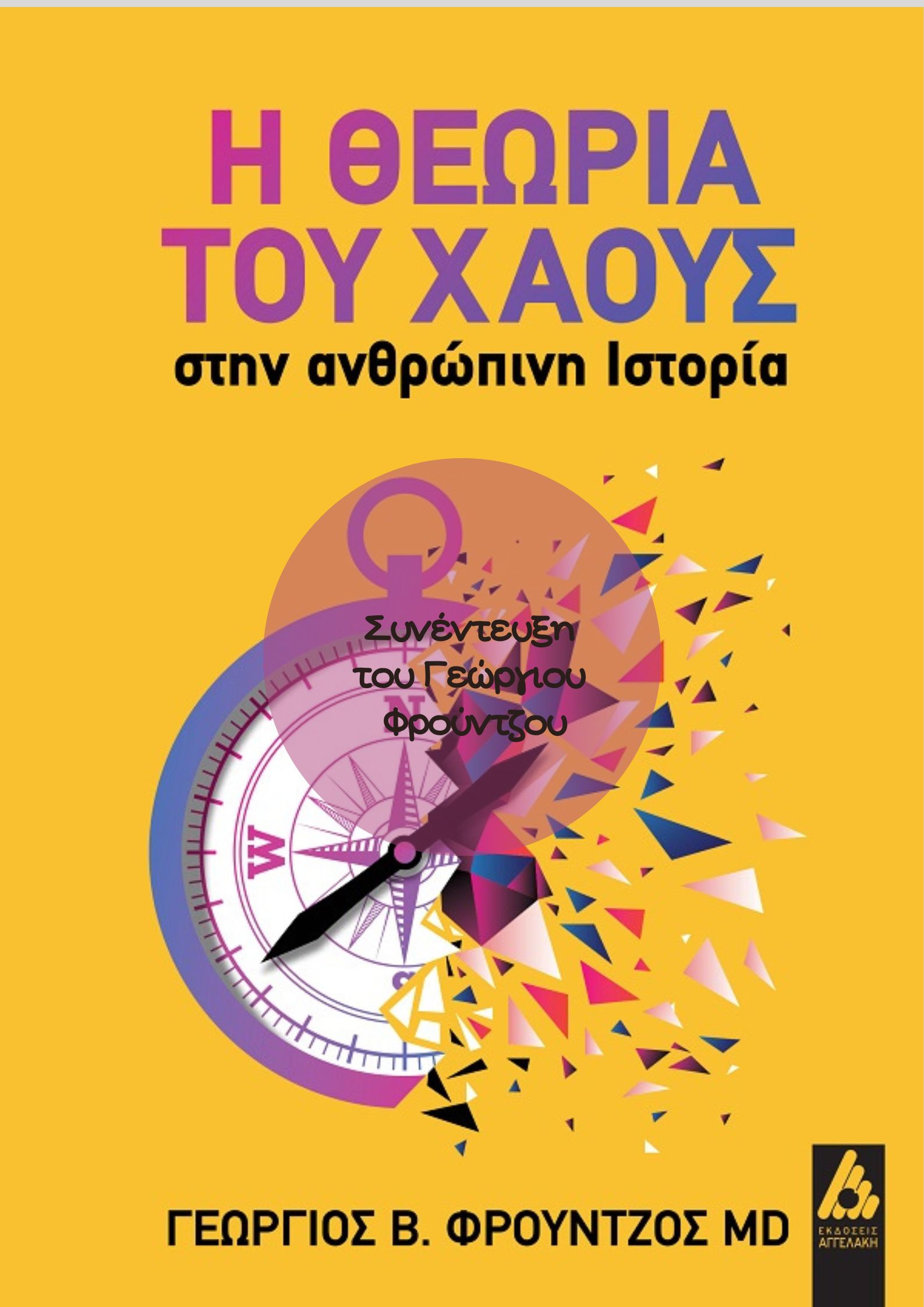
Essentially, it is a philosophy of History, through the modern scientific thinking of Chaos theories, systemic theory, social networks, etc. A great effort was made to make the text very accessible to an average reader. So I used a reading group of 15 people, with a variety of ages and educational subjects. This stage of corrections (more than 10 times) lasted about 2 years. The project in total took me more than 20 years, with over 250 books and articles in its bibliography. The entire text was carefully edited many times because I believe that knowledge should belong to everyone and can be easily read by everyone. On the Cover I collaborated with the talented and award-winning Kostis Pavlou. All this effort aims at a very good book about Greece, which has been taken care of in every detail. Angelakis Publications did an excellent job in both editing and pagination so that the text is very easy to read. So the writing and publishing had a lot of effort, enthusiasm and mood for an excellent result. I hope that every reader who will spend his time will be interested and liked. With respect to the reader, as Angelakis Publications writes on its back cover, which I thank very much for the excellent result.